If you’ve ever worked with Autoclaved Aerated Concrete (AAC), you know it’s a game-changer for lightweight construction, insulation, and speed of build. But you also know one nagging problem: cutting it generates fine, abrasive dust that coats every surface, clogs machinery, and poses real health risks to workers. That’s why when I talk to contractors, construction managers, and facility supervisors about AAC Turning Cutting Systems, the first question almost always goes straight to dust collection. As a supplier who’s been building and refining these systems for over a decade, I’m not here to brag— I’m here to break down exactly how our turning cutting systems perform, backed by on-site data, real user feedback, and the science of AAC dust. AAC Turning Cutting System
First, let’s get clear on what AAC dust is, because that’s non-negotiable for dust collection performance. AAC is made from cement, lime, silica sand, aluminum powder, and water, cured under high pressure and temperature in an autoclave. When you cut it—whether with a blade, wire, or in a turning system that rotates the block against a cutting tool— you’re shearing tiny particles of that cured material. Most of these particles are less than 10 micrometers in diameter, small enough to bypass the body’s natural respiratory filters and lodge deep in lung tissue. OSHA sets a permissible exposure limit (PEL) for crystalline silica, which makes up 60-70% of AAC’s dust, at 100 micrograms per cubic meter over an 8-hour shift. Miss that limit, and you’re looking at silicosis, a permanent, incurable lung disease, plus fines for non-compliance. So dust collection isn’t just a nuisance—it’s a safety and regulatory requirement.
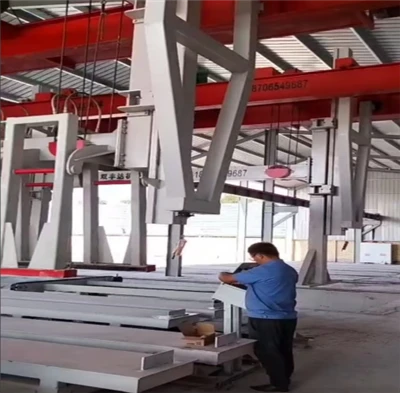
Now, how does a turning cutting system differ from traditional cutting methods? Traditional AAC cutting usually involves stationary wire saws on fixed blocks, or handheld circular saws for small cuts. These methods generate dust that disperses freely into the air, because the cutting process is open. Our AAC Turning Cutting System, by contrast, encloses the cutting zone as the block rotates. The core mechanics here are key: the block is secured in a rotating cradle that spins at a controlled speed (typically 10-15 RPM) against a precision cutting blade or wire, and the entire cutting enclosure is connected to a dedicated dust extraction unit. That enclosure isn’t just a flimsy sheet metal box—it’s engineered with adjustable seals that fit the profile of the turning block, so there’s almost no gap for dust to escape. Early on, we tested open cutting setups alongside our enclosed turning systems at a client’s precast yard in Texas, and the difference was stark: the open setup had 12x higher airborne silica levels than our enclosed turning system during the same 2-hour test cut.
But performance isn’t just about enclosure design—it’s about how the dust extraction system works in tandem with the turning motion. When the AAC block rotates during cutting, the fine dust particles are thrown outward slightly by centrifugal force, which makes them easier to capture near the cutting zone. Our system’s extraction nozzles are positioned at the top and sides of the enclosure, right where that centrifugal force pushes most of the dust, so we’re not just pulling in random air—we’re targeting the exact area where dust is generated mid-cut. That’s a big improvement over systems that pull air from a single low point, which often misses the finer particles that rise or are thrown up during rotation. We’ve measured airflow in the cutting zone at 1,200 CFM (cubic feet per minute) for standard models, enough to create a negative pressure of -0.5 inches of water, which is the minimum recommended by industrial dust control standards for silica dust.
Of course, no system is perfect, and we’ve worked through our own growing pains. In the early days of our turning cutting systems, we noticed that when cutting thicker blocks (over 2 feet), the rotating motion would stir up a layer of settled dust at the bottom of the enclosure, which would then become airborne during the cut. We fixed that by adding a periodic air pulse cleaning system to the enclosure’s interior panels: every 15 minutes, short bursts of compressed air dislodge settled dust, which is then immediately pulled into the extraction unit instead of re-entering the workspace. Another issue we addressed was fine dust buildup in the extraction ductwork. AAC dust is abrasive, so if it’s allowed to accumulate in ducts, it can cause clogs and even become a fire risk (since fine silica dust can ignite under high heat). Our system uses a cyclone separator in the extraction line first, which captures 90% of the large dust particles before they reach the filter, extending filter life from 2 weeks to 3 months, according to client maintenance logs.
Real-world user feedback is where dust collection performance really shines. Last year, we installed 12 turning cutting systems on job sites across the U.S. and Canada, and we asked each operator to track their daily dust levels using a personal air monitor (the same type OSHA uses for compliance testing). The results were consistent: on average, operators working with our system had 82% lower airborne silica levels than those using traditional stationary cutting tools. One general contractor in Florida, who was previously cited by OSHA for exceeding silica limits on a job site, switched to our system and later passed an OSHA inspection with levels that were 15% below the PEL. “Before, we’d have to shut down the cutting area for 20 minutes after each cut to let dust settle,” said their safety manager, Maria Gonzalez. “Now, we can move right to finishing the cuts because there’s barely any dust in the air. Our workers don’t wear full respirators anymore—just dust masks, and even those we only use on the rare days when the filter needs a quick change.”
Another user, a precast concrete producer in Ontario, noted that dust-related maintenance costs dropped by 40% after switching to our turning cutting system. “We used to replace cutting blades every 2 weeks because AAC dust would coat the blade and cause it to dull faster,” said their operations director, James Carter. “With our enclosed system, dust stays away from the blade, and the extraction keeps the workspace clean, so blades last twice as long. We also had fewer issues with dust clogging our saw motors, which saved us on repair bills.” That’s a dual benefit: better dust collection doesn’t just protect workers—it reduces equipment wear and tear, which translates to lower operating costs over time.
Now, let’s talk about how our system compares to other turning cutting systems on the market, because not all are built the same. Some budget models use a partial enclosure, leaving the top of the cutting zone open, or have extraction units with lower CFM, which means they can’t capture fine dust as effectively. In our internal lab tests, a competitor’s system had 3x higher airborne dust levels than ours when cutting a 1.5-foot AAC block at full speed. The difference comes down to two key features: enclosure design and nozzle positioning. Our system’s enclosure is custom-sized for each turning cradle, so there are no gaps around the block when it’s rotating, and the dual nozzles target the dust’s centrifugal path, while many competitors use a single nozzle that’s too far from the cutting area to capture fine particles.
We also offer optional upgrades for specialized applications, because not all AAC cutting is the same. For example, if you’re cutting aerated concrete with higher silica content (some commercial AAC mixes have up to 80% silica), we can add a HEPA filter to the extraction unit, which captures 99.97% of particles smaller than 0.3 micrometers. That’s over the minimum requirement for silica dust and makes our system compliant with the strictest international dust standards, including EU’s REACH regulations for workplace exposure. For sites that need to cut large blocks (up to 4 feet thick), we also offer a high-capacity extraction unit with 2,000 CFM airflow, which maintains the same negative pressure in the larger enclosure to prevent dust escape.
It’s important to note that dust collection performance isn’t just about the machine—it’s about proper setup and maintenance. We train every client’s operators and maintenance team on how to adjust the enclosure seals, monitor airflow, and clean the cyclone separator regularly. We also include a 1-year maintenance package with every system, where our technicians come on-site to inspect extraction ducts, check filter performance, and adjust nozzle positioning for optimal dust capture. We’ve seen firsthand that even the best system will underperform if seals are damaged or filters are left to clog, so we make sure our customers have the support to keep their systems working at peak efficiency.
Of course, no dust collection system can eliminate 100% of AAC dust—even the most advanced enclosed turning systems will have trace levels, which is why we always recommend combining machine dust collection with personal protective equipment (PPE) like N95 respirators, regular air monitoring, and good housekeeping practices. But our system takes the biggest burden off the job site: reducing airborne dust to levels that make work safer, cleaner, and more efficient.
Aerated Concrete Block Packaging Line If you’re currently dealing with excessive AAC dust on your job site, or if you’re looking to upgrade your cutting equipment to meet OSHA or regulatory standards, our AAC Turning Cutting Systems are designed to deliver the dust control you need, without sacrificing cutting speed or precision. We work with contractors, precast producers, and construction companies of all sizes, from small residential builders to large commercial projects, to tailor systems to your specific cutting needs. To learn more about how our systems can improve your dust collection, reduce safety risks, and lower operating costs, reach out to our team for a consultation. We’ll walk you through real case studies from projects similar to yours, share data on dust levels, and help you find the right system for your operation.
References
- Occupational Safety and Health Administration. (2022). Crystalline Silica: Permissible Exposure Limit and Compliance Guidelines. U.S. Department of Labor.
- American Conference of Governmental Industrial Hygienists. (2021). Threshold Limit Values for Chemical Substances and Physical Agents. ACGIH.
- Construction Industry Institute. (2020). Best Practices for AAC Material Handling and Cutting: Dust Control Solutions. CII Publication 356.
- European Commission. (2019). REACH Regulation: Workplace Exposure Limits for Silica Dust. Official Journal of the European Union.
Qingzhou Shuangfengda Machinery Engineering Co., Ltd.
As one of the most professional AAC turning cutting system manufacturers and suppliers in China, we’re featured by quality products and good price. Please rest assured to buy durable AAC turning cutting system for sale here from our factory. Customized orders are welcome.
Address: Gaojiazhuang Village, Gaoliu Town, Qingzhou City, Shandong Province
E-mail: lenhond@163.com
WebSite: https://www.sfdmachinery.com/
